The UK has a legally binding target to reduce its greenhouse gas emissions by 100% by 2050. According to The Net Zero strategy, in which plans are set out for reducing emissions from each sector of the economy, the UK has almost halved its greenhouse gas emissions since 1990. But as we move towards a low-carbon economy, there’s much more to do. Businesses and homeowners will have to work hard to minimise their future impact on the environment.
For those that are off-grid and without access to mains gas, carbon-based fuels such as liquified petroleum gas (LPG), oil, and solid fuels such as coal have long been reliable, cost-effective energy sources. Throughout the UK, hundreds and thousands of off-grid businesses, industries, and farms depend on bulk LPG as their energy source, but LPG does have an environmental impact due to the release of greenhouse gases and pollutants such as CO2, SO2 and NOx when burned.
Whilst LPG is often considered a cleaner-burning alternative to other alternative fossil fuels, as it has high combustion efficiency and burns almost completely so it omits fewer air pollutants, it is still a fossil fuel and isn’t completely green. At Robinsons Gas, we’re committed to doing all we can to protect our environment, both for now and for future generations, so the development of renewable gases is welcome and we’re looking forward to offering them as soon as they become commercially viable.
A sustainable future with renewable gases
Whilst the UK government has been championing heat pumps as the go-to solution for off-grid UK businesses and homes, they’re not suitable for every property and do come with their own pros and cons. They can be expensive to install, and often require significant and expensive property improvements to produce the same amount of heat as with alternatives such as LPG.
There are two renewable LPG gases on their way, both of which are not just greener but also can be used in existing systems, with no additional costs for refitting your system or any new equipment needed.
Firstly bioLPG, which can reduce your business’s carbon emissions by up to 90% with low NOx, SOx and particulate matter. Produced from renewable and organic feedstocks using a variety of technologies and thermal or chemical processes, it’s renewable and sustainable, is chemically identical to traditional LPG and compatible with existing LPG boilers and other appliances. It can be ‘dropped in’ to your existing LPG storage tank, and blended with your LPG, making it an easy and affordable transition process.
rDME (renewable dimethly ether) is another renewable gas coming soon that can also help the UK transition to a greener future. Produced from renewable feedstocks such as methane from agricultural and municipal waste, and through a process called methanol dehydrations or directly from synthesis gas produced by thermal gasification, carbon emissions are reduced by up to 85%. As it shares many characteristics with traditional LPG it can be blended with it and with bioLPG, as well as being used in its pure form.
Again, there is no need for modification to existing infrastructure as, like bioLPG, it is a drop-in solution so there are no retro-fit costs, making it an affordable and flexible energy solution.
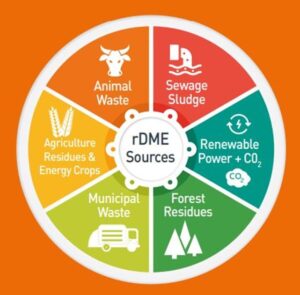
Image from Liquid Gas UK
Reducing emissions
Using LPG and renewable liquid gas offers a reliable and affordable means to reduce carbon emissions. For businesses and homes that currently use heating oil, choosing to switching to LPG will immediately reduce your impact on the environment, and help you to take the first step towards transitioning to renewable gases. According to Liquid Gas UK, the Trade Association for the renewable liquid gas industry (rDME, bioLPG and LPG) in the UK, switching from oil or coal to LPG would support reaching Net Zero by cutting your carbon footprint by 33% and up to 20% respectively.
Industry support
According to Liquid Gas UK, almost a third (31%) of energy usage in the UK is from the industrial, commercial, and agricultural sectors, from rural holiday parks and hotels to care homes and housing developments to name a few, with traditional fuels generating approximately 55% of this energy.
The good news for the renewable gas industry is that Liquid Gas UK launched its ambition to transition to 100% renewables by 2040 back in 2019 to support the Government’s target for a net zero future by 2050. Net Zero remains at the top of its agenda, as the Trade Association believes renewable liquid gases will play a critical role in the decarbonisation of off-grid energy, and it continues to take a leading role in consulting with the UK Government on policy framework.
George Webb, CEO, Liquid Gas UK, has said ‘It is clear that if the Government is serious about meeting its ambition to cut 78% of CO2 emissions by 2035, it must drop its one size fits all approach to decarbonizing heating’. Whilst acknowledging that heat pumps will have an important role to play, he went on to add ‘so too will LPG and bioLPG’.
Are LPG boilers going to be banned?
Whilst the government will need to decarbonise heating across the UK, there is currently no ban on installing or replacing an LPG boiler, as confirmed by Ed Miliband, Secretary for State for Energy Security and Net Zero when he spoke at The Energy Security and Net Zero Committee last month.
With industry and Government support, good things are on the horizon for renewable liquid gases with much to look forward to for the many off-grid businesses and homes throughout the UK. Expected to play a key role in the transition to a low-carbon economy, these sustainable energy sources will allow for a significant reduction in greenhouse gas emissions with no compromise on performance, helping to improve the air we all breathe.
If you’d like to talk to us about renewable gases, or you currently use an alternative energy source to LPG to fuel your business or home and would like to discuss switching to cleaner-burning and versatile LPG, get in touch on 01347 238177. Or perhaps you’re already using LPG and are interested in switching LPG supplier. We’re just at the end of the phone and our expert team is here to offer advice and help you on your journey to reduce your carbon footprint.