
Getting to know your bulk LPG tank and installation is important for every business whether you’re in industry, agriculture, hospitality, or any other sector. LPG is highly versatile and efficient, but it’s still a pressurised gas and can be a hazardous product if not handled and stored correctly.
Knowing how your LPG system works and understanding regulations and safety standards set by Liquid Gas UK, the Trade Association for the liquified gas industry in the UK, will help you ensure a safe working environment, prevent leaks, and avoid accidents, as well as ensure we continue to deliver to you safely.
Plus, understanding your system can ensure you optimise fuel usage and achieve maximum efficiency – so important for all businesses at this current time.
The regulations – what you need to know
First things first. When you switch supplier or start using LPG for the first time, you’ll need your LPG storage tank installing. At Robinsons Gas, our experienced in-house engineering team will ensure your LPG tank is installed seamlessly and in accordance with LPG storage tank regulations.
Tanks come in many sizes, from small 450 litres to 4,600 litres (2 tonne) tanks which are more suitable for commercial use. For businesses that use a large amount of gas, several tanks may be needed, which may be made up of a combination of sizes.
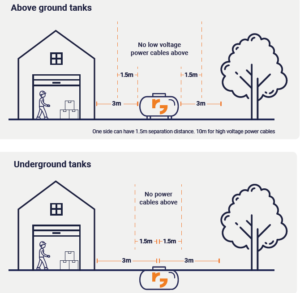
There’s also a choice of above-ground tanks or more discreet underground tanks. Above-ground tanks must be installed on a concrete hard-standing base and be 3 metres from buildings and boundaries, from sources of ignition and unsealed drains and gullies. There must always be a good line of site from the delivery wagon to the tank and access to and around the tank for deliveries and on-going maintenance.
Bulk underground LPG tanks are buried in a convenient and safe location, and have a 1-metre diameter lid which is all you see. There must be a distance of 3 meters from the centre of the tank lid to buildings and boundaries for safety and access. Other than that, requirements are much as with an above-ground tank.
Factors such as available space and your business’ usage will determine what size and type of tank will be your best solution.
Our guide below shows the tank safety distances for both above-ground and below-ground bulk LPG tanks:
Taking care of your installation – all you need to know
Whatever the size or number of LPG tanks your business requires, you have a responsibility to look after them and the surrounding area. It’s also vitally important that you make sure your tank continues to meet current rules and regulations.
Our in-house engineering team will regularly carry out ongoing maintenance, tank health checks and testing at intervals so we can make sure your set-up is working at its best. We carry out any required repairs that may be due to wear and tear or faults in the tank and fittings to ensure everything is safe.
But you also have a duty to maintain your tank, not only for safety reasons, but also to ensure a steady and efficient gas supply, and prevent unexpected shutdowns. The Gas Safety (Installation and Use) Regulations (GSIUR) require, in Regulation 35, that ‘it shall be the duty of every employer or self-employed person to ensure that any gas appliance, installation pipework or flue installed at any place of work under his control is maintained in a safe condition so as to prevent injury to any person’.
Some simple do’s and don’ts
Do’s:
- Draw up an inspection plan to inspect your tank regularly. Check for rust, corrosion, damage, and signs of leaks which can include a smell of gas, a hissing sound or dead vegetation in the area close to the tank
- Pipework can deteriorate over time – check the pipework regularly, ensuring valves, connections, and pipes are intact and not leaking
- Keep the area around your bulk LPG storage tank free of rubbish, debris, and overgrown plants
- Ensure the area around your tank is well-ventilated. Good airflow is essential in case of a leak to prevent the accumulation of gas
- Provide information and training to employees. Ensure staff know emergency procedures and safe operation
Don’ts
- Do not remove your tank’s emergency sticker – it’s there for a reason. The sticker contains important contact information in case of an emergency
- Do not paint your tank yourself. The colour of your LPG tank is light so it reflects heat and keeps the contents cool. By painting your tank in a darker colour, it will absorb more heat which can cause the inside pressure to rise. This can be dangerous, and possibly cause an explosion
- Do not interfere with your LPG installation. Any repairs or changes to your tank’s location must only be done by a GAS SAFE registered engineer
- Do not erect any new structures or buildings near your tank without consulting your LPG supplier to ensure any proposed changes conform to regulations
- Protect your tank from damage from vehicles by cordoning off the area where your LPG tank is located. Vehicles should be kept at least 6 meters from your LPG tank
- Do not allow anyone to smoke or use open flames in the area close to your tank
We understand that businesses have changing needs, for instance, a farmer may want to put up a new shed, or a hotel owner may wish to extend their premises or install a spa.
If you’re planning on making any changes to your business premises whether it’s to erect a new outbuilding or shed, to install electrical equipment, or to plant trees and shrubs, or you’re thinking about relocating your LPG tank, there are strict safety distances that must be adhered to, and you should not attempt to move your tank yourself. Leave it to the professionals!
Our engineers are highly trained and have specialised equipment, and our team can work with you to find the best location whilst ensuring everything is safe! Please get in touch with our experienced and friendly team first for help and advice.
Call us on 01347 238177. That way we can work with you to ensure your plans don’t compromise the safety of your installation and your employees. And don’t forget that adding new constructions or moving existing equipment could affect your pipework, ventilation requirements, and tank accessibility
Be emergency prepared
Knowing how to shut off the gas supply in the event of an emergency can make all the difference in the case of a gas leak or pressure issue. For your safety and that of your employees, it’s essential to familiarise yourself with the emergency control valve, typically located outside your premises at the point of gas line entry.
To turn off your gas supply, shut off the gas at your LPG tank. Open the tank lid, identify the location of the valve, and close the wheel by turning in a clockwise direction until fully closed.
To isolate your gas supply at the point of entry to your premises, first turn off all appliance taps and pilot lights, then turn the emergency control valve (ECV) to the ‘off’ position. The valve handle will be off when it’s at 90° to the pipe.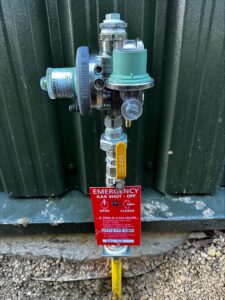
It’s important to remember that LPG is a very safe fuel when used and stored correctly. We’re your off-grid experts, so if you have any concerns surrounding your tank and installation, or spot any damage, get in touch with us immediately on 01347 238177. Our in-house engineering team is here to work with you and ensure optimum performance and safety at all times.